If you searched for Pixara vs ImagineArt pricing features and output quality compared 2026, the answer comes down to this: both are multi-model AI image and video platforms with entry plans around $9 to $13 a month, and the right pick depends on how much video you make, whether you need a free tier, and how many teammates share the account. This guide is for creators, marketers and small teams choosing one subscription.
Updated 14 November 2026. We checked Pixara's pricing page and public credit rules, ImagineArt's subscription plans documentation and its live subscription page on that date. Prices are as of 14 November 2026. Several numbers on both sides are temporary promotions, and ImagineArt shows local-currency prices by country, so your checkout may differ.
If you only need the ImagineArt side in detail, our ImagineArt pricing guide covers every plan and model cost. This post puts the two side by side, plan by plan and output by output.
Pixara vs ImagineArt pricing features and output quality compared 2026: which should you buy?
Pick ImagineArt if you want a daily free image tier, a $9 yearly entry plan or seats for up to 20 collaborators. Pick Pixara if you make video regularly, want lower prices for private generations, and want unlimited daily image models from Hobby. Output quality on shared models is the same; the price per usable output is not.
The short version by buyer type:
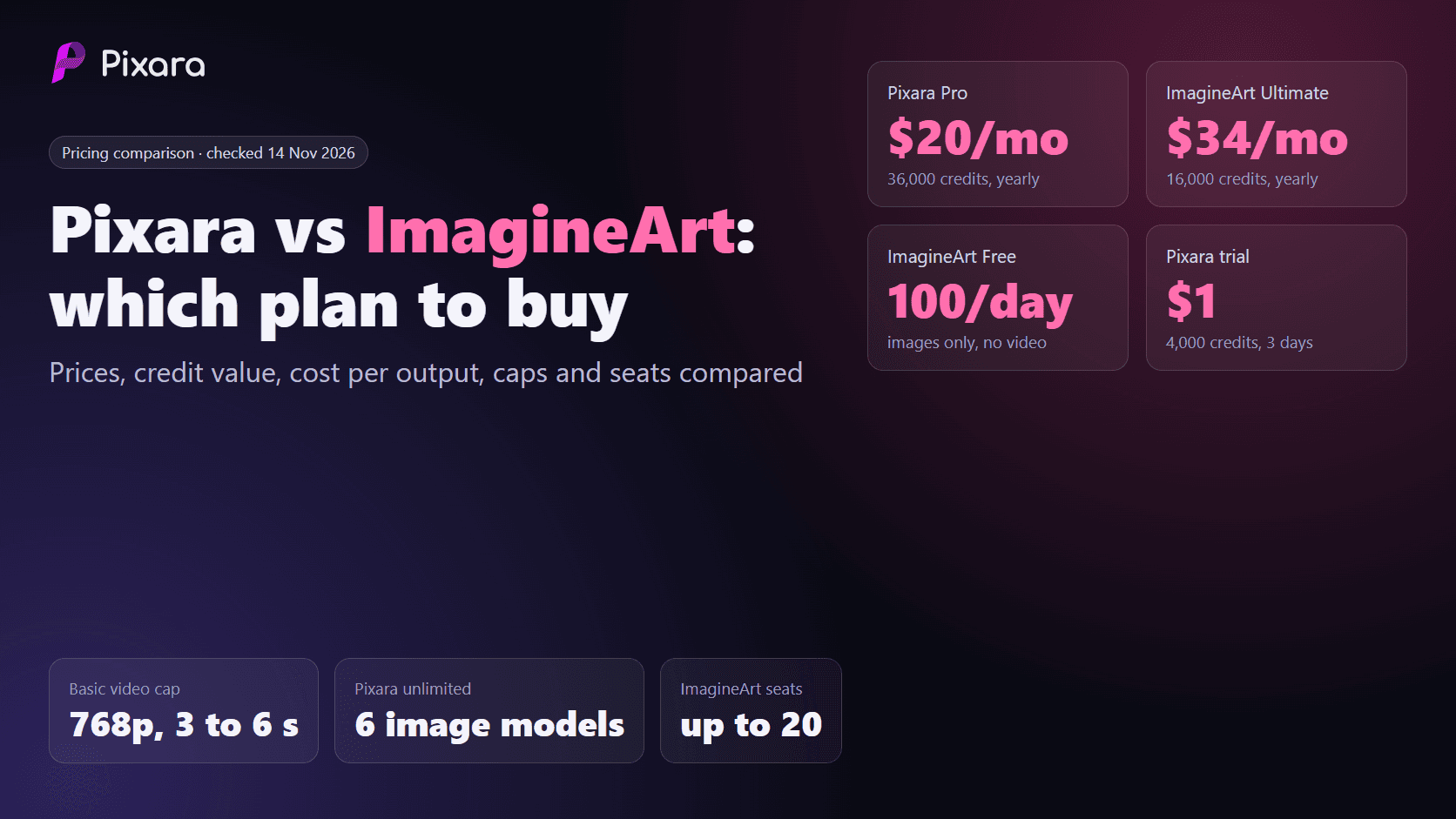
- Testing for free: ImagineArt. Its free plan gives 100 credits a day for images. Pixara's lowest step is a $1 trial for 3 days.
- Solo creator on a tight budget, mostly images: ImagineArt Basic at $9 a month yearly, or Pixara Hobby at $12 a month yearly if you want unlimited Nano Banana and private generations.
- Solo creator making video every week: Pixara Hobby or Pro. ImagineArt Basic caps video at 768p and 3 to 6 seconds.
- Freelancer or small studio with client work: Pixara Pro at $36 monthly or $20 yearly for 36,000 credits, private by default, against ImagineArt Ultimate at $50 monthly or $34 yearly for 16,000 credits.
- Team of 5 or more sharing one account: ImagineArt Ultimate, Creator or Business, because collaborator seats are written into its plans.
- High-volume agency or ad team: Pixara Ultimate at $75 a month yearly for 150,000 credits, against ImagineArt Creator at $83 a month yearly for 45,000 credits.

Pixara and ImagineArt plans side by side, with monthly and yearly prices and monthly credits, checked 14 November 2026.
How much does each plan cost, side by side?
Pixara's plans run $10, $18, $36 and $150 a month on monthly billing, or $10, $12, $20 and $75 a month billed yearly. ImagineArt's run $13, $50 and $120 monthly, or $9, $34 and $83 yearly, plus a $250 Creator tier. At similar prices, Pixara's plans carry more credits, but credits are not the same unit.
Pixara plans as of 14 November 2026
The monthly prices below are Pixara's current Black Friday promotion, with the list price in brackets. Yearly prices are the effective monthly cost, billed once a year.
- Starter: $10 a month, or a $1 trial for 3 days with 4,000 credits, then $10 a month. Yearly is also $10 a month ($120 a year). 4,000 credits. Generations are public. 2 concurrent generations, 2 GB storage.
- Hobby: $18 a month (list $25), or $12 a month yearly ($144). 15,000 credits. Unlimited daily use of 2 image models, with Unlimited Nano Banana highlighted. Optional private generations. 4 concurrent, 25 GB.
- Pro: $36 a month (list $60), or $20 a month yearly ($240). 36,000 credits. All 6 unlimited daily models. Private by default. 8 concurrent, 50 GB.
- Ultimate: $150 a month (list $250), or $75 a month yearly ($900). 150,000 credits. All 6 unlimited models. Private by default. 16 concurrent, 100 GB.
Every Pixara plan includes every model, plus Workflows, Ara (Pixara's agent) and MCP. Plans differ in credits, unlimited models, privacy, concurrency and storage, not in model access.
ImagineArt plans as of 14 November 2026
ImagineArt bills monthly, quarterly or yearly. The figures below come from its documentation and subscription page.
- Free: $0. 100 credits a day, refreshed daily. Images on select models only, such as ImagineArt 1.0 Lite and Flux Dev. No premium models and no video.
- Basic: $13 a month, $11 a month quarterly ($33), or $9 a month yearly ($108). 3,000 credits a month. Premium video models included, video up to 768p and 3 to 6 seconds, no Last Frame, public generations. 4 concurrent image and 2 video jobs, 1 personalized element. Single user.
- Ultimate: $50 a month, $41 quarterly ($125), or $34 a month yearly ($410). 16,000 credits. Unlimited generation on 10 select models. Private generations. Ad, Fashion and Film Studios. Video up to 4K, 3 to 12 seconds, Last Frame. 12 concurrent image and 4 video jobs. Up to 6 collaborators, priority queue.
- Creator: $120 a month, $100 quarterly ($300), or $83 a month yearly ($1,000). 45,000 credits. A larger tier gives 100,000 credits for $250 a month, or $175 a month yearly ($2,100). Unlimited generation on 20 select models. 16 image and 5 video concurrent jobs. Up to 20 collaborators.
- Business: Teams at $60 per seat a month for 2 to 5 seats with 16,000 credits per seat, pooled. Scale at $200 per seat a month for 5 to 15 seats with 100,000 credits per seat and SSO. Enterprise is custom.
Matching the tiers
The names do not line up: Pixara's Ultimate is its top plan, ImagineArt's Ultimate is its middle plan. Matched by price, Starter faces Basic, Pro faces ImagineArt Ultimate, Pixara Ultimate faces Creator, and Hobby has no ImagineArt rival.
The missing middle tier matters. An ImagineArt Basic user who outgrows 3,000 credits jumps from $13 to $50 a month on monthly billing, unless they buy top-ups. On Pixara, Starter to Hobby is an $8 step at current promo prices.
With the plans lined up, the quickest next step is to open Pixara's pricing page and check the plan that matches your budget row above.

What is one credit worth on Pixara and on ImagineArt?
A Pixara credit is worth $0.0025 on Starter, $0.0012 on monthly Hobby, $0.0010 on monthly Pro and Ultimate, and as little as $0.0005 on yearly Ultimate. An ImagineArt credit is worth $0.0043 on monthly Basic down to $0.0018 on yearly Creator. That does not mean Pixara is always cheaper, because each platform charges different credits per model.

Dollar value of one credit on each Pixara and ImagineArt plan, monthly and yearly billing, checked 14 November 2026.
The full list, as of 14 November 2026:
- Pixara Starter: $0.0025 per credit.
- Pixara Hobby: $0.0012 monthly, $0.0008 yearly.
- Pixara Pro: $0.0010 monthly, $0.000556 yearly.
- Pixara Ultimate: $0.0010 monthly, $0.0005 yearly.
- ImagineArt Basic: $0.0043 monthly, $0.0030 yearly.
- ImagineArt Ultimate: $0.0031 monthly, $0.0021 yearly.
- ImagineArt Creator: $0.0027 monthly, $0.0018 yearly.
Credit value is only half the price. The other half is how many credits each platform charges for one output, and that varies by model. ImagineArt's own estimate of about 600 images from 3,000 credits implies a basic image model at around 5 credits. Pixara charges 34 credits for a Nano Banana 2.1 image at 1K. Multiply both and the per-image cost can look very different from the per-credit cost.
Pixara founder Shahzeb Khalid puts the reason plainly in Pixara's own guidance: "AI generation does not have one universal cost. Generating a still image, producing a short video, creating a voiceover, and processing a high quality video can involve very different amounts of computing resources."
What does one image and one video cost on each platform?
On a basic model, ImagineArt is cheap: about $0.02 per image and $0.13 per video on monthly Basic, based on its own plan estimates. On named premium models, Pixara is usually cheaper per output on Hobby and above. A Midjourney image costs $0.12 on monthly Pixara Hobby against about $0.26 on monthly ImagineArt Basic.

Cost per image and per video on selected models and plans for Pixara and ImagineArt, worked out from published credit costs, checked 14 November 2026.
ImagineArt on its basic models
ImagineArt describes each plan in outputs on a basic model. Basic's 3,000 credits make about 600 images or 96 videos. Ultimate's 16,000 make about 3,200 images or 516 videos. Creator's 45,000 make about 9,000 images or 1,500 videos. That works out to roughly 5 credits per image and about 31 credits per video.
In dollars, using ImagineArt's own credit values:
- Basic monthly: about $0.022 per basic image and $0.13 per basic video.
- Basic yearly: about $0.015 per image and $0.094 per video.
- Ultimate yearly: about $0.011 per image and $0.066 per video.
- Creator yearly: about $0.009 per image and $0.056 per video.
Those are the cheapest numbers in this guide. The caveat is "on a basic model": the estimate does not name the video model, resolution or length, and Basic caps video at 768p and 6 seconds. For a named model such as Seedance 2.5 or Kling, check the credit cost ImagineArt shows before you budget.
ImagineArt on named premium models
Pixara's own ImagineArt pricing research found these per-image costs: Z Image Turbo at 5 credits, Midjourney V7 at 60 and Nano Banana Pro at 4K at 160. In dollars:
- Midjourney V7 (60 credits): $0.26 on Basic monthly, $0.18 on Basic yearly, $0.19 on Ultimate monthly, $0.13 on Ultimate yearly, $0.11 on Creator yearly.
- Nano Banana Pro at 4K (160 credits): $0.69 on Basic monthly, $0.48 on Basic yearly, $0.34 on Ultimate yearly.
Pixara on named models
Pixara publishes per-model credit costs and shows the cost before you generate. Selected image costs:
- Nano Banana 2.1 at 1K (34 credits): $0.085 on Starter, $0.041 on monthly Hobby, $0.027 on yearly Hobby, and unlimited daily on Pro and Ultimate.
- Midjourney (100 credits): $0.25 on Starter, $0.12 on monthly Hobby, $0.08 on yearly Hobby, $0.056 on yearly Pro, and unlimited daily on Pro and Ultimate.
- Nano Banana Pro at 1K (150 credits): $0.18 on monthly Hobby, $0.12 on yearly Hobby, $0.083 on yearly Pro.
Note the resolution difference on Nano Banana Pro: the ImagineArt figure is for 4K and the Pixara figure is for 1K, so they are not a like-for-like pair.
Selected video costs for a 5 second clip:
- Seedance 2.5 at 720p (1,330 credits): $3.33 on Starter, $1.60 on monthly Hobby, $1.33 on monthly Pro, $1.06 on yearly Hobby, $0.74 on yearly Pro, $0.67 on yearly Ultimate.
- Kling 4.0 at 720p (785 credits): $1.96 on Starter, $0.94 on monthly Hobby, $0.63 on yearly Hobby, $0.44 on yearly Pro.
- Seedance 2.0 Mini at 480p (175 credits): $0.44 on Starter, $0.21 on monthly Hobby, $0.14 on yearly Hobby, about $0.10 on yearly Pro.
- Pika 2.2 at 720p (200 credits): $0.50 on Starter, $0.24 on monthly Hobby, $0.16 on yearly Hobby, $0.11 on yearly Pro.
The honest read: if a basic ImagineArt video at 768p is good enough for your use, ImagineArt's per-clip cost is hard to beat. If you need named frontier video models at 720p or 1080p, Pixara lets you price each clip exactly, by second and resolution, before you run it. For more per-model math, see our Seedance 2.0 credits per video breakdown and the Kling AI pricing guide.
What do realistic monthly budgets buy on each platform?
At $10 a month, both platforms give you a public, entry-level plan: 4,000 Pixara credits or 3,000 ImagineArt credits. At $20 to $50 a month, Pixara Pro gives more than twice the credits of ImagineArt Ultimate. At $75 to $85 a month yearly, Pixara Ultimate gives 150,000 credits against 45,000 on ImagineArt Creator.
Budget 1: about $10 a month, mostly images
ImagineArt Basic yearly ($9 a month) gives 3,000 credits, about 600 basic images by its estimate, public and single user. Pixara Starter ($10) gives 4,000 credits, about 117 Nano Banana 2.1 images at 1K, also public. For basic-model social posts, ImagineArt gives more images. If you mostly use the original Nano Banana model, Pixara Hobby at $12 yearly is better, since Hobby's plan card highlights unlimited Nano Banana.
Budget 2: about $12 to $20 a month, weekly social video
Say you post 20 short videos and about 200 images a month. On Pixara Hobby yearly ($12 a month, 15,000 credits), 20 Seedance 2.0 Mini clips at 720p and 5 seconds use 7,500 credits. The images go on unlimited Nano Banana. That leaves 7,500 credits for about 9 Kling 4.0 clips at 720p.
ImagineArt has no plan at this price. Basic covers the volume on a basic model, but clips are capped at 768p and 6 seconds and stay public. The next step is Ultimate at $34 yearly.
Budget 3: about $20 to $50 a month, client work
Privacy matters here, so compare the private plans. Pixara Pro is $20 a month yearly or $36 monthly for 36,000 credits, private by default, with all 6 unlimited image models. At 5 seconds and 720p that is about 45 Kling 4.0 clips or 27 Seedance 2.5 clips before promos. ImagineArt Ultimate is $34 a month yearly or $50 monthly for 16,000 credits, private, with 10 unlimited models, 4K video up to 12 seconds and 6 collaborators.
Working alone, Pixara Pro costs less a month and includes every model plus 6 unlimited image models. Needing 4K or several teammates, ImagineArt Ultimate has features Pixara Pro does not list.
Budget 4: about $75 to $175 a month, high volume
Pixara Ultimate yearly is $75 a month for 150,000 credits. At 1080p and 5 seconds, Kling 4.0 costs 1,175 credits, so 60 hero clips use 70,500 credits, about $35 of that month's value, with room left for drafts. ImagineArt Creator yearly is $83 a month for 45,000 credits, or $175 a month for 100,000, with 20 unlimited models and up to 20 collaborators.
For a solo high-volume creator, Pixara's credit count wins. For an agency where 10 or more people need logins, ImagineArt's seats may be worth the higher cost per credit.
Budget for retries, not finished outputs
Your real cost is per usable output. Shahzeb Khalid makes the point in Pixara's own guidance: "If a campaign requires ten finished images, you may need to generate more than ten options before finding the versions that meet your requirements." If you usually keep 1 clip in 3, multiply every per-clip figure above by 3 before you choose a plan.
Which free plan or trial is better for testing?
ImagineArt has the better free option for images: 100 credits a day, refreshed daily, with no payment. It does not include video. Pixara has no free plan in its pricing, but the $1 trial gives 4,000 credits for 3 days across every model, including video, which is the faster way to test video models.
ImagineArt Free
The free plan refreshes 100 credits every day on select image models, such as ImagineArt 1.0 Lite and Flux Dev, without premium models. It is good for learning prompts, not for judging the video models you might pay for.
Pixara's $1 trial
The trial costs $1 for 3 days with 4,000 credits, then renews as Starter at $10 a month unless you cancel. Because every Pixara plan includes every model, the trial lets you test video. With 4,000 credits you could make about 3 Seedance 2.5 clips or about 5 Kling 4.0 clips at 720p and 5 seconds, about 20 Pika 2.2 clips, or about 22 Seedance 2.0 Mini clips at 480p.
Starter generations are public, so keep client work off the trial. For other no-cost options across the market, see our list of the best free AI video generators.
What are the video caps and settings on each platform?
ImagineArt ties video quality to the plan: Basic caps clips at 768p and 3 to 6 seconds with no Last Frame, while Ultimate and Creator unlock up to 4K and 3 to 12 seconds with Last Frame. Pixara does not cap models by plan. It charges per second by resolution, so higher settings simply cost more credits.
ImagineArt's caps by plan
- Free: no video.
- Basic: premium video models included, up to 768p, 3 to 6 seconds, no Last Frame, 2 video jobs at once.
- Ultimate: up to 4K, 3 to 12 seconds, Last Frame, 4 video jobs at once, priority queue.
- Creator: the Ultimate video features plus 5 video jobs at once.
Last Frame lets you set where a shot ends, which helps you join clips into a sequence. Basic users cannot do that.
Pixara's pricing by setting
On Pixara the plan decides how many credits you have, not which settings you can use. The model and settings decide the cost:
- Seedance 2.5: 119 credits a second at 480p, 266 at 720p and 654 at 1080p.
- Seedance 2.0: 180 credits a second at 720p. Seedance 2.0 Mini is 75 at 720p and 35 at 480p.
- Kling 4.0: 157 credits a second at 720p and 235 at 1080p. Kling 3.0 is 84 a second at standard, without audio.
- Wan 3.0: 100 credits a second at 720p standard.
- Pika 2.2: 200 credits for 5 seconds at 720p, 450 for 5 seconds at 1080p.
Each model keeps its own native limits on resolution and length, so check the model page before planning a long clip. Our Seedance 2.0 model page and Kling 3.0 model page show the settings for those two.
If you mostly make video and want to choose resolution and length per clip instead of per plan, Pixara's credit model is the simpler fit, and its Hobby plan starts at $12 a month yearly.

How do the unlimited-model offers compare?
Both platforms offer unlimited generation on some models without spending credits. Pixara gives 2 unlimited image models on Hobby and 6 on Pro and Ultimate: Nano Banana, Nano Banana 2.1, GPT Image 2, Seedream 5 Lite, Reve 2.1 and Midjourney. ImagineArt gives 10 select models on Ultimate and 20 on Creator, and nothing unlimited on Basic.
Pixara's unlimited daily models
- Starter: none.
- Hobby ($12 yearly, $18 monthly): unlimited daily use of 2 image models, with Unlimited Nano Banana highlighted on the plan card.
- Pro and Ultimate: all 6, Nano Banana, Nano Banana 2.1, GPT Image 2, Seedream 5 Lite, Reve 2.1 and Midjourney.
That list matters because Midjourney costs 100 credits per image on Pixara and 60 credits on ImagineArt. On Pixara Pro, Midjourney images do not use credits, which frees your full 36,000 for video.
ImagineArt's unlimited models
- Basic: none.
- Ultimate ($34 yearly, $50 monthly): unlimited generation on 10 select models, with no credits used.
- Creator ($83 yearly, $120 monthly): unlimited generation on 20 select models.
ImagineArt names its select models on its subscription page, and the list can change. Check it before you buy, including whether the models are image or video. A bigger number only helps if it includes the models you use.
The cheapest way into unlimited image generation is Pixara Hobby at $12 a month yearly. All 6 of Pixara's unlimited models cost $20 a month yearly on Pro, against $34 for ImagineArt's 10. If the models you need are only on ImagineArt's list, its offer is the better one for you.
For a wider look at platforms that bundle many models in one subscription, see our guide to the best multi-model AI video platforms.
Is output quality different between Pixara and ImagineArt?
On a shared model, no. Both platforms run many of the same third-party models, including Seedance, Kling, Nano Banana, GPT Image, Runway and Grok. When you pick the same model at the same settings, the model produces the image or video. Differences come from which models each offers, plan caps, available settings and cost per usable output.
If both sites send your prompt to the same Kling or Seedance model, the platform is not making the picture. We did not run test generations for this guide, and we would not trust a quality score that hides which model and settings were used.
Where real quality differences come from
- Which models are available. Pixara's catalog includes Veo 3.1, Kling 4.0 and O3, Seedance 2.5, Nano Banana Pro, GPT Image 2.5, Midjourney, Seedream 5 Pro, Grok Imagine, Flux 3, Runway Aleph, Hailuo 3, Luma Ray 3.2, PixVerse V6, Pika 2.2, Krea 2 and Wan 3.0. ImagineArt names families including Kling, Seedance, Seedream, MiniMax, Nano Banana, Gemini, Qwen, GPT Image, Runway and Grok, plus its own models.
- Plan caps. A 768p, 6 second clip on ImagineArt Basic will look worse than a 1080p clip from the same model on another plan, because the settings differ, not the model.
- Settings you can reach. Last Frame, resolution and duration change what you get. On ImagineArt some are plan-gated. On Pixara they are priced per credit.
- Cost per usable output. If a model takes 3 tries to get a clip you keep, the cheaper platform per clip lets you afford those tries. That is a quality factor in practice.
What to do instead of trusting a test
Pick the 2 or 3 models you would actually use. Check that both platforms offer them, then compare the resolution, length and per-output cost each allows. On Pixara the credit cost appears before you generate, so you can price a test without spending. Shahzeb Khalid gives the same advice in Pixara's own guidance: "Beginners should check the generation settings and estimated cost before running multiple generations."
For model-level quality comparisons rather than platform ones, our Nano Banana vs Seedream 4.0 and Midjourney vs GPT Image 2.5 posts compare the models directly.
Which features matter beyond price?
The features that change the decision are privacy, team seats, storage, built-in tools and agents. ImagineArt leads on seats and has Ad, Fashion and Film Studios on Ultimate. Pixara includes Workflows, its Ara agent, MCP, lip sync, voice clone, 150+ language video translation and upscaling on every plan, with storage from 2 GB to 100 GB.

Feature comparison of Pixara and ImagineArt plans on privacy, unlimited models, concurrency and team seats, checked 14 November 2026.
Privacy
- Pixara: Starter generations are public, shared with the community. Hobby offers optional private generations. Pro and Ultimate are private by default.
- ImagineArt: Basic generations are public. Ultimate and above are private.
The cheapest private plan is Pixara Hobby at $12 a month yearly, against ImagineArt Ultimate at $34. If you do client work or product launches, that $22 a month gap matters.
Team seats
- ImagineArt: Basic is single user. Ultimate allows up to 6 collaborators, Creator up to 20. Teams costs $60 per seat a month for 2 to 5 seats with 16,000 pooled credits per seat. Scale costs $200 per seat for 5 to 15 seats with 100,000 credits per seat and SSO.
- Pixara: the plan cards we checked list credits, concurrency, storage and privacy, not collaborator seats. If several people need their own logins, confirm with Pixara before you buy.
ImagineArt's seat structure is clear and written down, and that is a real reason to choose it.
Tools and workflow
Pixara includes Workflows, the Ara agent, MCP, lip sync, voice cloning, ElevenLabs voices, 150+ language video translation and Topaz upscaling on every plan. ImagineArt adds Ad, Fashion and Film Studios on Ultimate, and Basic includes 1 personalized element.
What about rollover, refunds, commercial use, legacy plans and promos?
Neither platform rolls over plan credits. ImagineArt refreshes credits monthly even on yearly billing; Pixara refreshes each cycle. Pixara's one-time bundles stay until used, and ImagineArt sells top-up packs. Both run temporary video promos in November 2026, and ImagineArt's legacy plans follow older terms.
Rollover and top-ups
- Pixara: plan credits refresh each cycle and do not roll over. One-time credit bundles can be added and those credits stay until used. Check the bundle prices on the pricing page.
- ImagineArt: credits never roll over and refresh monthly, even on quarterly or yearly plans. Top-up packs cost $10 for 1,000 credits, $20 for 3,000, $40 for 8,000, $100 for 26,000 and $200 for 66,000. Auto top-up is available.
Packs fall from $0.010 per credit at $10 to about $0.0030 at $200. A $10 pack costs more per credit than any subscription, so monthly pack buyers should usually upgrade.
Refunds and cancellation
ImagineArt says payments are subject to its refund policy, so read it before a yearly purchase. Pixara lets you change or cancel your plan anytime. Neither page we checked promises a refund for unused credits, so assume a yearly plan is a yearly commitment.
Commercial use
ImagineArt's paid plans list General Commercial Terms. For Pixara, confirm usage terms in Pixara's Terms of Service before client work. On both, the terms of the underlying third-party model may also apply.
Legacy plans
ImagineArt treats plans bought before 27 September 2025 as legacy, and Standard is a legacy plan. If you are on one, check your own subscription page, because the current caps and credit counts may not apply to you.
Promotions in November 2026
- Pixara: monthly prices on Hobby, Pro and Ultimate are a Black Friday promotion. Seedance 2.5 generations are 40% off and Kling V3 generations are 50% off for now.
- ImagineArt: Seedance 2.5 and 2.0 are up to 50% off every video until 30 November. Prices show in local currency by country.
Promotions end. Budget at list price and treat any discount as a bonus. If you are comparing several year-end offers, our Black Friday AI deals for 2026 list collects them.
Who should pick ImagineArt?
Pick ImagineArt if you want a free daily image tier, a low-cost basic plan for simple images and short clips, or written seat limits for a team. It is also the better pick if the models you rely on are on its list of 10 or 20 unlimited models, or if you need its Ad, Fashion and Film Studios.
- Free image users. 100 credits a day, refreshed daily. Pixara does not offer that.
- Budget users happy with basic models. Basic's 600 images or 96 videos for $9 a month yearly is the cheapest per output here.
- Teams of 2 to 20, or companies that need SSO. Ultimate (6 collaborators), Creator (20) and Scale seats with SSO are clearly defined.
- Studio users. Ad, Fashion and Film Studios come with Ultimate and above.
Who should pick Pixara?
Pick Pixara if you make video often, want every model on every plan, or want unlimited image models at a lower price. Pixara Hobby at $12 a month yearly is the cheapest private plan with unlimited image generation in this comparison, and Pro at $20 a month yearly gives 36,000 credits plus all 6 unlimited models.
- Video-first creators. No plan caps on settings, and the credit cost is shown before each clip.
- Solo pros and freelancers. 36,000 credits for $20 a month yearly on Pro.
- Heavy Midjourney, GPT Image 2 or Nano Banana users. All unlimited daily on Pro and Ultimate.
- One wallet for many models. The same credits pay for Veo, Kling, Seedance, Runway, Pika and Krea 2.
Shahzeb Khalid sums up the multi-model argument in Pixara's own guidance: "AI models are developing at an incredible pace, and no single model is necessarily the best choice for every creative task." Our guide to the cheapest AI video generator ranks options by cost per clip if you want to check that against the wider market.
Who should skip Pixara and ImagineArt?
Skip both if you only use one model and its maker sells it cheaper direct, if you need a free video tier, or if your work needs credits that roll over. Skip Pixara if you need many named logins today. Skip ImagineArt if you need private video above 768p for under $34 a month.
- Skip both if you need free video. Neither offers video at $0. Look at plans with free video credits in our free AI video generator roundup.
- Skip both if you use one model only. A single-model subscription can be simpler. Compare against the model's own pricing, for example our Midjourney pricing guide.
- Skip both if you need rollover. Plan credits expire on both. Pixara's bundles and ImagineArt's packs are the only way to hold credits.
- Skip Pixara if you need confirmed team seats today, or want a free plan rather than a $1 trial.
- Skip ImagineArt if you need private generations under $34 a month or clips over 6 seconds on a budget.
Other options: Krea's plans start at $9 a month or $5 yearly for 5,000 units, and Pika's plans at $10 a month for 600 credits. See also our OpenArt pricing and Freepik alternatives guides.
What is the final verdict by buyer type?
For most solo creators who make video, Pixara Hobby or Pro is the better value. For free image use, budget basic-model output and teams that need written seat limits, ImagineArt is the better fit. Match the plan to your monthly output and privacy needs, not to the headline price.

Recommended Pixara or ImagineArt plan for each buyer type, based on prices and features checked 14 November 2026.
- Just exploring, images only: ImagineArt Free.
- Testing video before you commit: Pixara $1 trial, 4,000 credits for 3 days.
- Under $10, simple images and short public clips: ImagineArt Basic at $9 a month yearly.
- Solo creator, weekly social video, wants privacy: Pixara Hobby at $12 a month yearly or $18 monthly.
- Freelancer or small studio, client video: Pixara Pro at $20 a month yearly or $36 monthly.
- Needs 4K plus up to 6 collaborators: ImagineArt Ultimate at $34 a month yearly or $50 monthly.
- Agency with up to 20 people: ImagineArt Creator at $83 a month yearly, or Business seats.
- High-volume solo operator: Pixara Ultimate at $75 a month yearly for 150,000 credits.
Still unsure? Run the $1 Pixara trial and a week of ImagineArt Free side by side, on the same models where both have them, and divide each price by the outputs you keep.
How we checked
We read Pixara's pricing page and public credit rules, ImagineArt's subscription plans documentation and ImagineArt's live subscription page on 14 November 2026. We also used Pixara's earlier ImagineArt pricing research for three ImagineArt per-image model costs. Every price and credit figure in this guide comes from those sources.
Dollar costs per output are our arithmetic: published credits per output multiplied by each plan's price per credit (plan price divided by monthly credits). ImagineArt's basic-model costs come from its own plan estimates, not from a named model.
We did not run generations or score output quality, because both run many of the same third-party models. Where a figure was not published, such as Pixara seat counts, we say so. Prices differ by country and promotions end, so your checkout page is the final word.
That is Pixara vs ImagineArt pricing features and output quality compared 2026 in one line: ImagineArt wins on free images, basic-model price and team seats, and Pixara wins on every model at every tier, cheaper privacy and unlimited image models for video-heavy work. If you make video every week, Pixara Hobby at $12 or Pro at $20 a month yearly is the plan to start with.